Showing posts with label Nectar Plants. Show all posts

Wednesday, July 10, 2013

A Petite School Butterfly Garden


Another project I was working on recently was installing a small butterfly garden at my children's school garden. We had a limited budget and small space but lots of enthusiasm!

Here is the space before... lots of weeds and too much shade. However, there was one existing milkweed plant. It always amazes me how they manage to grow in less than ideal circumstances.


The children helped clear the area of debris and weeds. We added nectar (zinnias, marigolds, pentas) and host plants (milkweed and parsley), mulch, and bricks for edging. Some of the milkweed plants were transferred from other parts of the garden where they had just popped up.


The children were so eager to work in the garden - it was impressive. And they were so excited to find caterpillars in the garden just two weeks later. Success!

Looking for caterpillars


Saturday, June 29, 2013

More Summer Snapshots!

I found this chubby caterpillar crawling up the milkweed this morning. Maybe he was looking for a good place to spin his chrysalis?

Monarch caterpillar

This Monarch butterfly stayed still for this photo longer than I expected. Monarchs really enjoy sipping the nectar from our Butterfly Bush.

Monarch on Butterfly Bush

My dear friend Donna (who is a wonderful photographer!) sent me this beautiful shot from her garden. Purple coneflowers are one of my favorite nectar plants. The bees like them too!

Donna Williams Photography

Wednesday, June 12, 2013

Summer Snapshots!


In the garden today...

Gulf Fritillary on purple Vinca


Young Black Swallowtail caterpillars (3) on parsley
in the kitchen garden. I need to plant more parsley!

Monday, April 29, 2013

Yay! We are Monarch Waystation 6425!


There was a recent story on NPR's Science Friday about the serious decline of the Monarch population.  Dr. Lincoln Brower, a biologist,  was interviewed about this sad news and he encouraged listeners to plant more milkweed! You can play an active role in this by planting a Monarch Waystation. By planting milkweed, you can help sustain Monarchs during their incredible migration.

We have been working towards getting our butterfly garden certified as a Monarch Waystation and we finally did it! Here is our sign hanging proudly in the garden.


You can learn more about working towards and certifying your butterfly garden here. It can be a small garden or a large garden - just plant milkweed!!


Please let me know if you have any questions about establishing your Monarch Waystation! I'm happy to help!

Monday, April 8, 2013

Places: South Seas Island Resort Butterfly Garden

Just back from Spring Break with my family in Captiva Island, Florida. What a beautiful place... aqua water, white sand beaches laden with shells, and fresh seafood. Needless to say, it was so hard to leave!

Gulf of Mexico

As part of South Seas' ScoutAbout program, they have a colorful butterfly garden. The weather was cool by South Florida standards, so I didn't see many butterflies flying about. However, the garden was lush and full of blooms.

Tropical Milkweed, Giant Milkweed, Daisies, Lantana, Pentas, Firespike, Salvia, Clusia

I find the Tropical Milkweed more dramatic en masse...
More Tropical Milkweed

Short milkweed in front & tall milkweed towards the back

Each ScoutAbout Point of Discovery provides educational information about local flora and wildlife. My children really enjoyed exploring the resort in search of these and collecting bracelets along the way. It was a big adventure!


Saturday, October 27, 2012

Giant Swallowtail

The variety of butterflies that I've been able to attract to the garden at our "new" house verses our "old" house still surprises me. I recently found a Giant Swallowtail for the first time flying about my Meyer Lemon tree and sipping from the Lantana.

To my delight, she laid some eggs!

The Giant Swallowtail is commonly found all over Florida. Well, Florida IS known for its citrus and this is the Giant Swallowtail's host plant. You may have heard of the "orangedog?" This is the common name for its caterpillar which is sometimes considered a pest to citrus growers. Large citrus trees can tolerate loosing some leaves to orangedogs but young, smaller ones might have a difficult time.  It is a large yellow and black butterfly averaging 5 1/2 inches wide. Note it's yellow body in my photo above.  


In case your wondering, her caterpillars did not do much damage to my lemon tree at all - there were definitely enough leaves to share!

References: 
McAuslane, H.J. (2011).  Giant Swallowtail, Orangedog, Papilio cresphontes Cramer (Insecta: Lepidoptera: Papilionidae). Retrieved from http://edis.ifas.ufl.edu/in134 .

Friday, October 12, 2012

Places: Pollinator Garden, San Diego Zoo


We recently travelled to San Diego for a family wedding. What a beautiful city! I loved seeing the Pacific Ocean, roses in bloom, succulents in lovely containers, and fuchsia bougainvillea.  Yes, the weather is perfect there!

We made our way to the San Diego Zoo and it was amazing!


I was delighted to find this garden there...

Bees, Butterflies, & Hummingbirds (Three of my favorite things)

There were brightly colored nectar plants like butterfly bush, pentas, zinnias, lantana, and coneflowers.


And lots of milkweed growing in the greenhouse and in front of it.


Wow, I would love a greenhouse full of milkweed!


The garden has plenty of winged visitors like this monarch.


For more information about the San Diego Zoo, click here! Happy gardening!

Thursday, August 2, 2012

Birds & Blooms: "Butterfly Gardening Myths"


Hello butterfly gardening friends... I'm just back from vacation with my family. We were visiting the Pacific Northwest  - stay tuned for some butterfly photos from our trip!

Our friends at Birds & Blooms magazine sent me their wonderful butterfly gardening article in their current issue (August/September 2012)...


Plant It and They Will Come - Butterfly Gardening Myths Revealed in the Current Issue of Birds & Blooms Magazine
Attracting butterflies to your garden just got a whole lot easier thanks to Birds & Blooms Magazine.  The current issue is debunking butterfly gardening myths and discovering the truth about getting these beauties to your yard, and increase your chances for success.  According to the article, it really can be as simple as – “plant it and they will come.”  If you plant a patch of milkweed, you’re bound to get monarchs.  If you have an out-of-the-way corner for nettles, get ready to welcome red admirals.  To check out the myths and truths about butterfly gardening featured in this month’s issue, pick up a copy of Birds & Blooms or visit http://www.birdsandblooms.com/mag to attract even more butterflies by planting flowers that will last into fall.


Well, you can read the article right here. They were so nice to allow me to share the article with you on Milkweed Gardens! Enjoy!


Wednesday, June 27, 2012

Lots and Lots of Rain

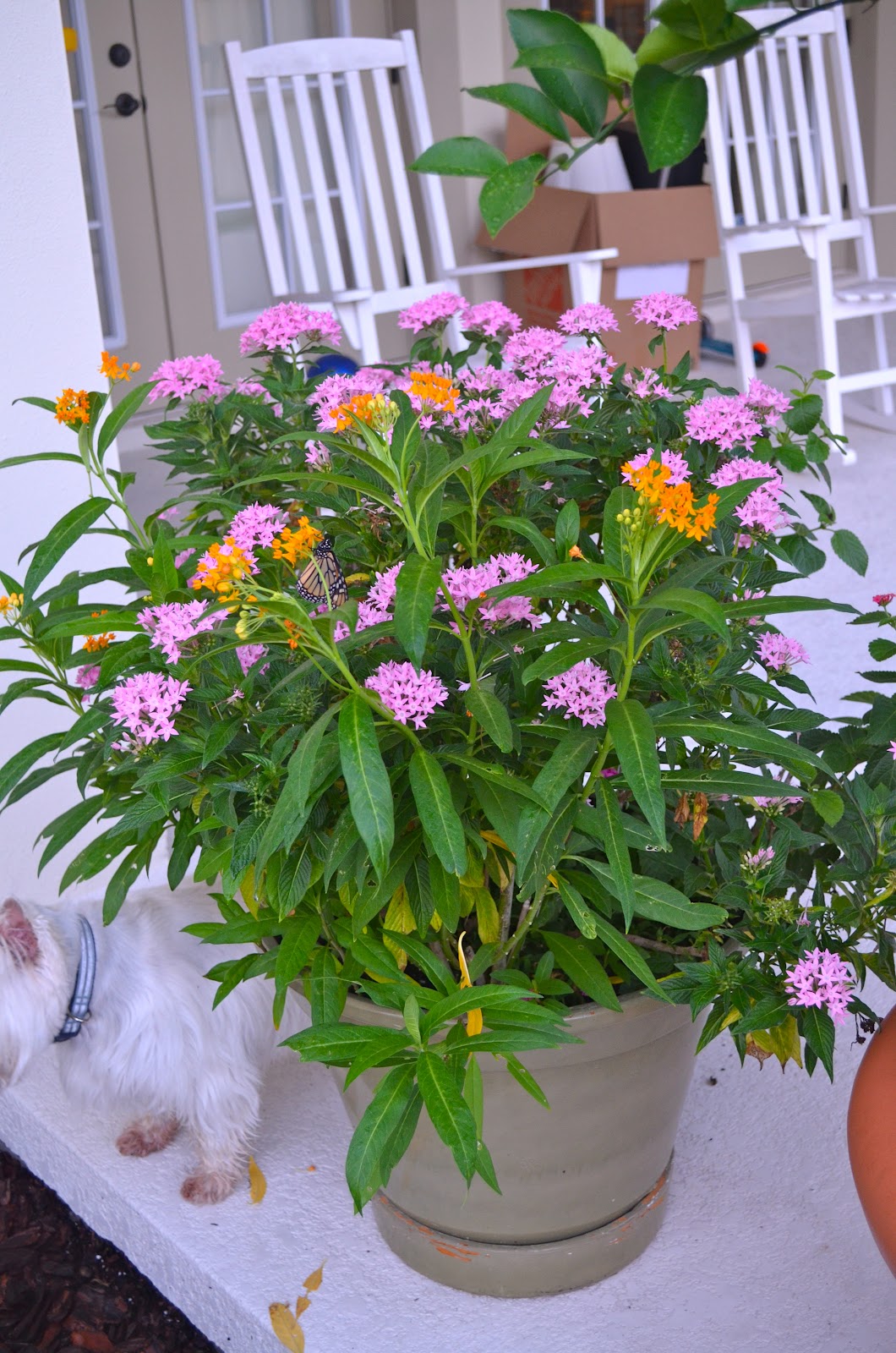
We have had lots and lots of rain recently due to Tropical Storm Debby. I found this Monarch trying to dry its wings in my butterfly container on my patio yesterday. He was still there this morning. Now that the weather has finally started to clear, he has flown away.


Some of you might be interested to see how this butterfly container has evolved since this post. I fertilized it about six weeks ago and the pentas and butterfly weed are quite vibrant now.


Tuesday, January 10, 2012

Overlook Milkweed

We went to Disney last weekend - my husband ran the Disney Marathon and had an awesome run! As we took a walk around the Wilderness Lodge one evening, we came upon this scenic overlook.


As I looked out over the hotel grounds, I noticed some orange flowers right in front of me: milkweed! What a nice surprise!


That's my son enjoying the view too! Have you ever come across milkweed in any unexpected places?

Monday, January 2, 2012

Change & the New Year


"If nothing ever changed, there'd be no butterflies."


My poor blog has been neglected over the past few months and I have missed it! I have been working on a new business with my husband and trying to tend to my garden here and there. Things have finally settled down and I can return to writing here on Milkweed Gardens (I hope!).

I hope the New Year has started off well for you... my milkweed patch is full of caterpillars but there is a cold front approaching. I plan to cover the patch later today to try and protect those caterpillars. They are still young and need another 1-2 weeks to mature. I noticed several tiny eggs under the milkweed leaves as well.


Happy New Year to all of my gardening friends! I hope your garden is full of butterflies!

Friday, September 9, 2011

Purple Coneflower

I'm back! I was on a brief hiatus while getting my children ready to return to school. Now they have settled in and I can return to my blog (Yeah!). I took this picture earlier this year while on vacation in North Florida and have been meaning to write about it ever since.

Purple Coneflower (Echinacea purpurea)

Purple Coneflower (N) is a wonderful nectar plant. Okay, I admit I am impartial to pink (one of my favorite colors) but I also love how these blooms stand up and reach for the sun.


They grow 2-4 feet tall and bloom in the spring and summer here in Central Florida. They prefer light shade which promotes flower and leaf color. Aside from attracting butterflies, Purple Coneflower is also useful as cut flowers, mass plantings, or as a border in the garden. 

Thursday, June 2, 2011

Bee balm (Monarda punctata)

Hello Gardening Friends! I have been preoccupied with end of the school year activities recently but things are now coming to an end. It was a fun and busy year that honestly, went by quickly!


Bee balm


Today I would like to tell you about Bee balm (Monarda punctata). My daughter and I came across some Bee balm growing around Lake Baldwin during our one of our walks.  It is also known as Spotted Horsemint, Dotted Horsemint, and Spotted Bee balm.  This is a wonderful nectar plant that also attracts hummingbirds.  I also love its crownlike appearance. It is a perennial native that grows 1.5 - 3 feet tall in full sun with tall pinkish flowers. Bee balm is moderately drought tolerant and not easily affected by pests and diseases. This makes it an easy plant to grow and it looks lovely en masse in a perennial border. An interesting note about Bee balm is native Americans use  it to brew a “sweating tea.” 


Reference
Gilman, E. amd Terry Delvalle, T. Monarda punctata Bee Balm, Horsemint. Retrieved June 2, 2011, from http://edis.ifas.ufl.edu/fp413

Wednesday, May 11, 2011

Bambi's Butterfly Garden

This year's butterfly garden at the EPCOT Flower and Garden Festival WAS bigger and better! I really enjoyed it's scale and scope - such a nice variety of host and nectar plants in a woodland setting. It also included a chrysalis house,  butterfly identification and life cycle signs, and a puddle.  I'd say there was a moderate amount of butterflies. We saw Monarchs, Queens, Gulf Fritillaries, Zebra Longwings, and a Giant Swallowtail.

Entrance to the garden. We were given packets of Zinnia seeds here.

Bambi's Butterfly Garden is this year's theme.

Queen Butterfly on Bambi

I found these stick trellises inspiring. There was passionvine and coral honeysuckle growing on them.

A puddle for the butterflies to sip from.

Chrysalis House

Queen caterpillar on Milkweed

Butterfly Topiary outside of the garden. The topiaries are one of our favorite features of the whole festival.

The festival ends on the 15th so there is only a few days left to visit Bambi's Butterfly Garden!
 

2010 Design by sweet cheeky designs